
The Boardroom Ledger
Executive Summary
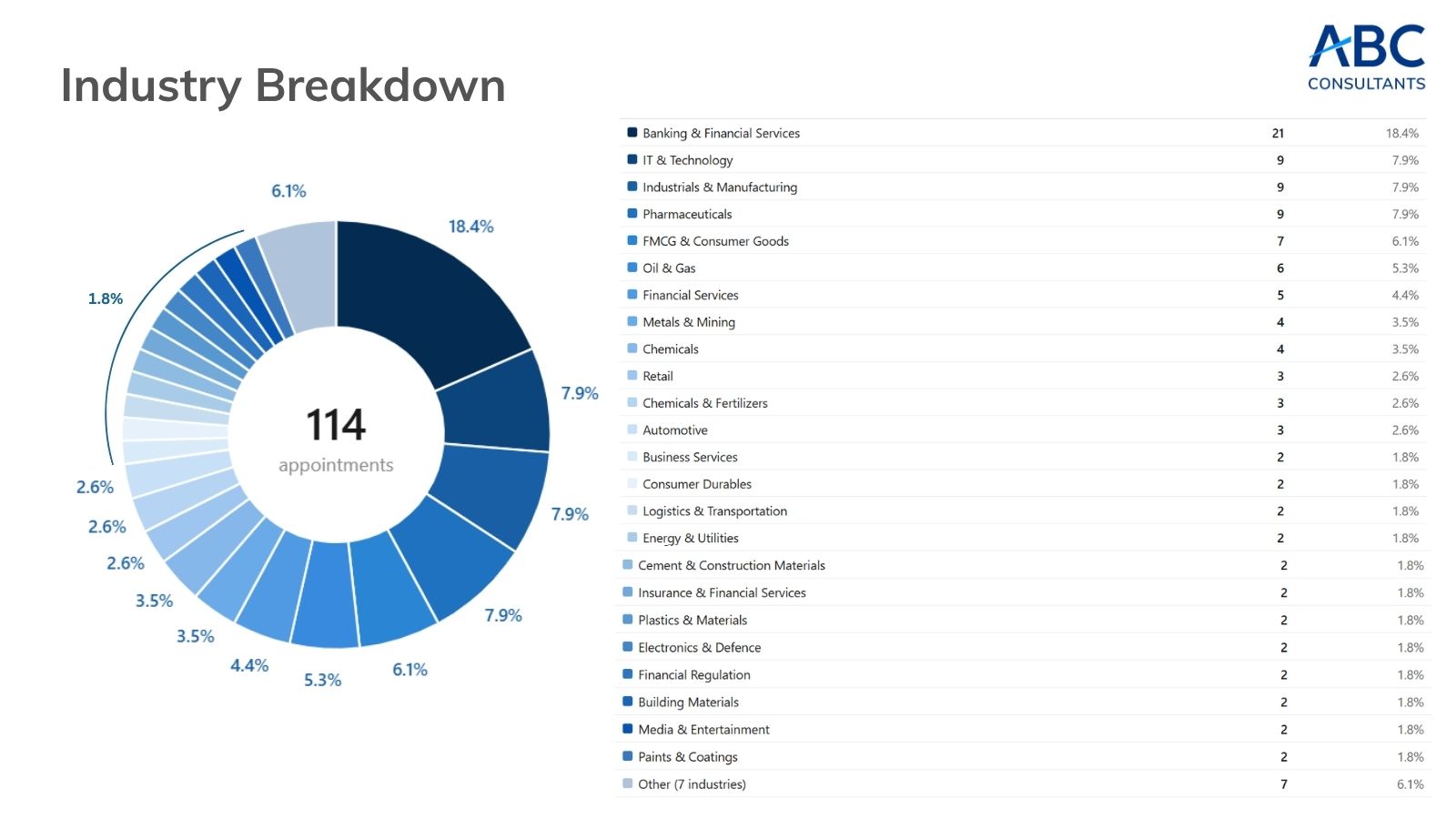
- Banking & Financial Services leads in appointment volume, driven by regulatory scrutiny, succession pressures in small finance banks, and high-profile transitions across marquee institutions such as HDFC Bank, ICICI Bank, and Kotak Mahindra Bank.
- Pharmaceuticals emerges as the second-most active sector, marked by CEO transitions at Cipla and JB Chemicals, alongside fresh independent director appointments across Lupin, Eris Lifesciences, Emcure, and Sanofi India.
- Women directors account for 19% of appointments (slightly below the NSE Top 200 average of 20%) with notable exceptions including Neelam Dhawan at Delhivery and Kalpana Unadkat at Avenue Supermarkets in chairperson roles.
- Regulatory strengthening is evident, with SEBI reaching full board strength following the appointment of Kompella Venkata Ramana Murty as Whole-Time Member after over a year of vacancies.
- PSU boards saw active movement across Oil & Gas (ONGC, GAIL, BPCL, Mahanagar Gas) and infrastructure (Dredging Corporation of India), reflecting government-led leadership transitions.
The Governance Landscape
The approach to Board composition brings distinct priorities to each organisation that ultimately converge toward building effective governance.
Boards in India’s Promoter-driven landscape and Family Offices are hiring for trust, alignment, and long-term continuity. When a Promoter brings someone onto a Board, it’s not only about governance but also finding someone who understands the family’s vision, respects the unspoken dynamics within the business and can be a sounding board without disrupting the internal power structure.
The listed versus unlisted distinction matters enormously here. In listed companies, everything is in the public domain and scrutiny is real. In unlisted family businesses, even advisors navigate uncharted territory. The persistent question: how do we attract a credible, senior name to this board when information is limited and the environment isn’t fully transparent? That’s a very different challenge than what MNCs face.
Regardless of organisation type, the emphasis on good governance is unequivocal. Boards are expected to demonstrate independence, meet regulatory and investor expectations and operate with transparency under increasing stakeholder scrutiny while supported by more structured processes and defined criteria.
India now has nearly 300 family offices, up from around 45 in 2018. As they professionalize and look toward listings or PE entry, they’re beginning to adopt Global governance frameworks. This is creating demand for a new kind of board director who needs to be fluent in both worlds.
Where Governance Urgency Is Highest
Financial services leads without question. Regulatory pressure from SEBI, RBI, and IRDAI has been relentless and the governance failures over the last decade have made boards in this space acutely aware of what weak oversight costs. There’s genuine urgency, not just compliance fatigue.
The RBI’s ongoing supervisory reforms, SEBI’s focus on board independence and director accountability, and IRDAI’s heightened attention to policyholder protection are all converging simultaneously. Boards in this sector need to be ahead of these changes, not reactive.
Private equity-backed companies are a close second. As PE has become more deeply embedded in the Indian market, the governance expectations it brings have reset the bar for boards. PE players want directors who aren’t just ornamental, but who can actively participate in value creation, risk oversight, and strategic pivots.
Fintech and new-age financial platforms are entering a more scrutinized phase as regulators develop more precise frameworks for digital lending, payments infrastructure, and AI-driven financial products. Companies that scaled quickly under relatively light oversight should expect the governance conversation to intensify.
Startups entering growth or pre-IPO stages are actively reshaping their boards. As they prepare to face public markets or institutional investors, the need to replace informal advisory structures with serious governance infrastructure is real and time-sensitive.
Infrastructure and real estate, particularly with accelerating airport, logistics, and industrial corridor development, will face governance pressure as public and private capital intersects.
Related-party transactions, land acquisition transparency, and environmental compliance will all attract closer board-level attention.
The urgency across all these sectors is driven by a combination of regulatory tightening, investor scrutiny, and a hard-earned understanding that a passive board isn’t a neutral asset but a liability.
The Challenges Boards Are Struggling to Solve
The struggles are layered, and they’re not always the ones that make it into formal briefs.
The Supply-Quality Mismatch
There’s no shortage of people who want board seats. The number of certified independent directors in the country has grown significantly, but the certification, for a long time, could be obtained with minimal bar. The new regulatory framework that requires a formal board appointment before a certificate is granted is a step in the right direction, but the talent quality question remains live.
Stamp Paper vs. Expert
Beneath the surface, what boards are really grappling with is the tension between familiar faces and actual expertise. Directors are sometimes chosen due to their association with the Promoters and not necessarily to fill a skill gap in the Board. This practice is now challenged by evolving business complexity whether it’s AI governance, cybersecurity oversight, ESG accountability, or cross-border regulatory exposure.
The Diversity Reality
Despite SEBI mandating women directors, 77% of BSE-200 companies still have only one or two women on their boards. Regulation has done what it can. We’re now in a phase where the conversation needs to shift from compliance to genuine inclusion of diverse thinking.
Succession Planning Gaps
Both for board members and for key leadership positions, succession planning remains deeply underdeveloped. In promoter-led companies especially, the next generation is often assumed to be the natural successor. That assumption is increasingly being challenged, and boards are being asked to manage transitions far more thoughtfully than before.
Where Board-Ready Talent Lives and Where It Doesn’t
Financial services continues to produce the most board-ready talent, simply because of the depth of governance experience and regulatory exposure that comes with careers in banking, insurance, and capital markets. Former regulators, retired banking executives, and experienced CFOs from this sector have long been the default pool for board recruitment across industries.
Technology and consulting are emerging as strong pipelines for younger, more diverse profiles. Executives who have led large digital transformations, managed complex technology risk, or built out global capability centers have become genuinely sought-after on boards, particularly as companies grapple with AI governance and cybersecurity.
The Scarcity Zones
Deep supply chain or manufacturing governance experience at the board level is rare. Cross-industry moves, while theoretically appealing, often falter when sector-specific regulatory demands are too steep. A retail executive on a financial services board, for instance, can bring consumer and brand perspective, but will need a learning curve on a regulatory or risk committee.
At the functional level, the gaps are sharper than most companies acknowledge publicly. ESG professionals with genuine operational experience remain rare. India’s push toward sustainability reporting and carbon accountability is generating regulatory demand faster than the talent pipeline is filling up. Organisations need board members who can ask the right questions on ESG disclosures, not just ones who can read a report.
Technology governance is similarly stretched. 70% of Asian boards identify digital transformation as their most pressing board agenda topic, yet only 28% of organizations have recruited directors with AI expertise. The demand far exceeds the qualified supply.
The Untapped Geography
The Indian diaspora represents an underexplored resource. Senior Indian professionals in Singapore, the UAE, the UK, and North America bring functional expertise as well as an outsider’s perspective on governance which are genuinely valuable for Indian boards navigating international expansion or cross-border compliance. The barriers are time zones, regulatory familiarity, and promoter comfort with physical distance. These barriers are reducing, but slowly.
The Near-Term Outlook
Broadly, any industry that has adopted AI in its core operations without a corresponding governance framework is sitting in a vulnerable position. Regulators globally are signaling that AI governance will become a formal oversight responsibility of the board, not just a management function.
The shift most significant for the next 6-12 months is from oversight to active strategic engagement.
Boards that are still primarily monitoring and approving will find themselves inadequate for the environment we’re entering. The expectation from regulators, from PE investors and from institutional shareholders is that boards contribute to navigating disruption, not just ratifying management decisions.
What Boards Genuinely Need
At a foundational level, what boards need is the courage to ask uncomfortable questions and the intellectual confidence to challenge management when the answers are too comfortable. That’s a capability no certification confers. It comes from directors who are appointed for what they know and what they’re willing to say, not for their association with the right networks or their willingness to stay quiet in a room.
Download the full report here : https://drive.google.com/file/d/13u4w8clE0a8nFzQfk7S5gqkRR4erSiqW/view